15 Apple Macbook Pro Review (2016 Touch Bar) Vs Old Vs New
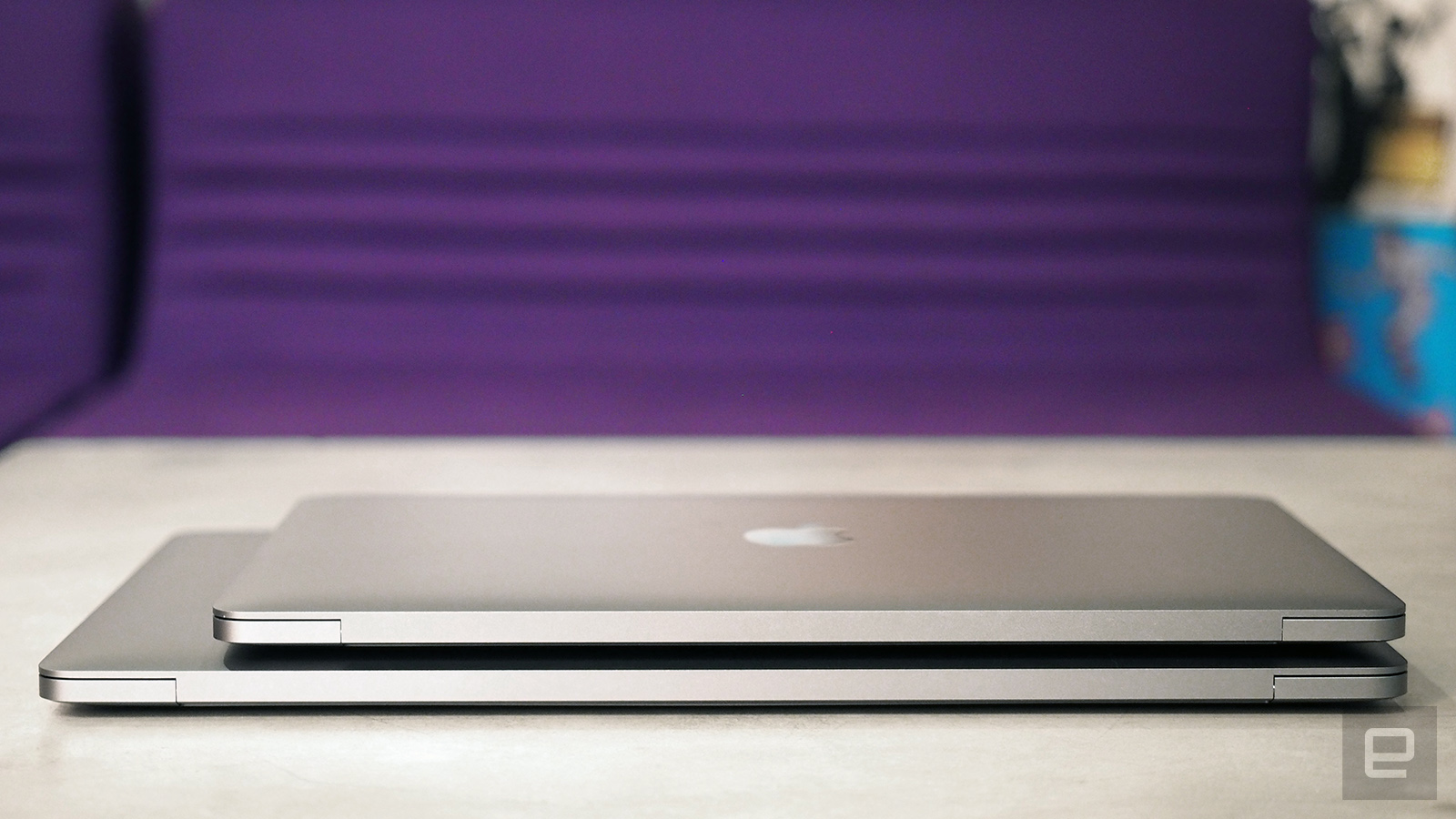
Whatever contempt I used to have for Apple's Force Touch trackpads has faded with time, as they're now the standard on the company's newer laptops. Apple has past now fooled me into assertive that I'1000 all the same clicking a push, when really I'1000 bearing downwards on a fixed, unmoving piece of glass with a vibrating haptic engine underneath. It's partly thanks to trackpads like this that Apple tree is able to make its notebooks as thin as they are.
Personally, I notwithstanding don't make much utilise of the various pressure-sensitive Forcefulness Touch gestures bachelor to me. I could carry downwards to fast-frontward through an iTunes movie or peek at a file in Finder, but information technology never occurs to me to do and so. I sometimes open up a lexicon preview for a word in an article I'yard reading, but I pretty much do it only past accident. The thing that makes Force Bear on about special, then, remains lost on me. But at to the lowest degree the touchpad is spacious and does well at the nuts: tap-to-click, unmarried-finger tracking, ii-finger scrolls and pinch-to-zoom.
Affect Bar
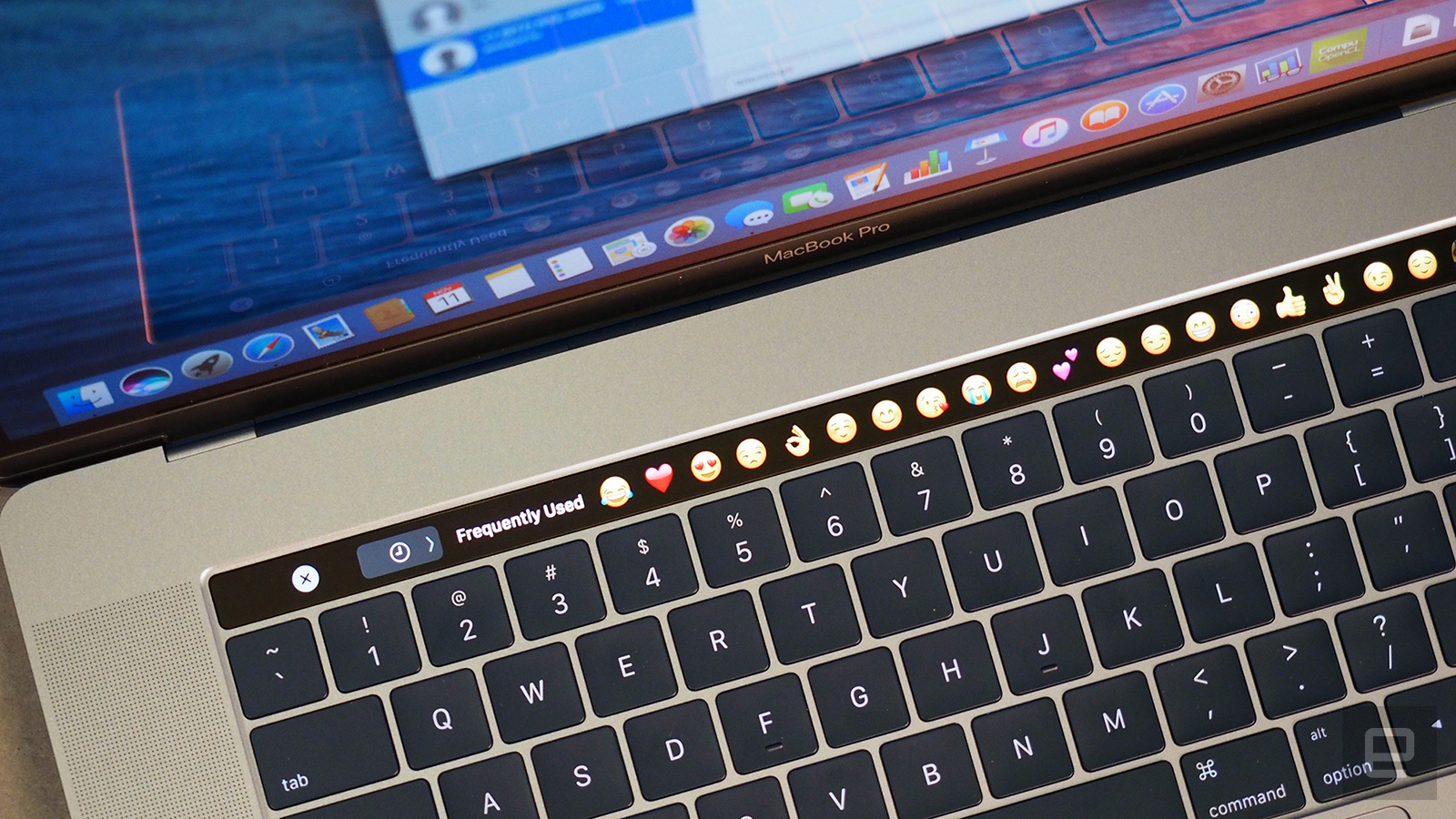
Apple sees the Bear upon Bar as an extension of the mouse and keyboard. That ways that, although it's technically a 2nd brandish, you won't come across it used equally such. Y'all won't see a moving stock ticker, for example. No Facebook notifications. You can only use the Touch Bar in situations where y'all already use a Mac (or iOS!) keyboard. Every bit information technology turns out, that by and large includes office buttons, give-and-take suggestions, emoji and a whole lot of sliders.
By default, when you boot upwardly your Mac and aren't in any particular app yet, you'll run into the Escape key at the far left of the Touch on Bar (where information technology belongs) and a handful of icons over on the correct. From right to left, that includes Siri, the mute push and volume and brightness shortcuts. Those Touch Bar shortcuts are all programmable, with options to add, remove and reorder shortcuts. You do this not in the System Settings, where you might look, but from the View menu on the desktop.
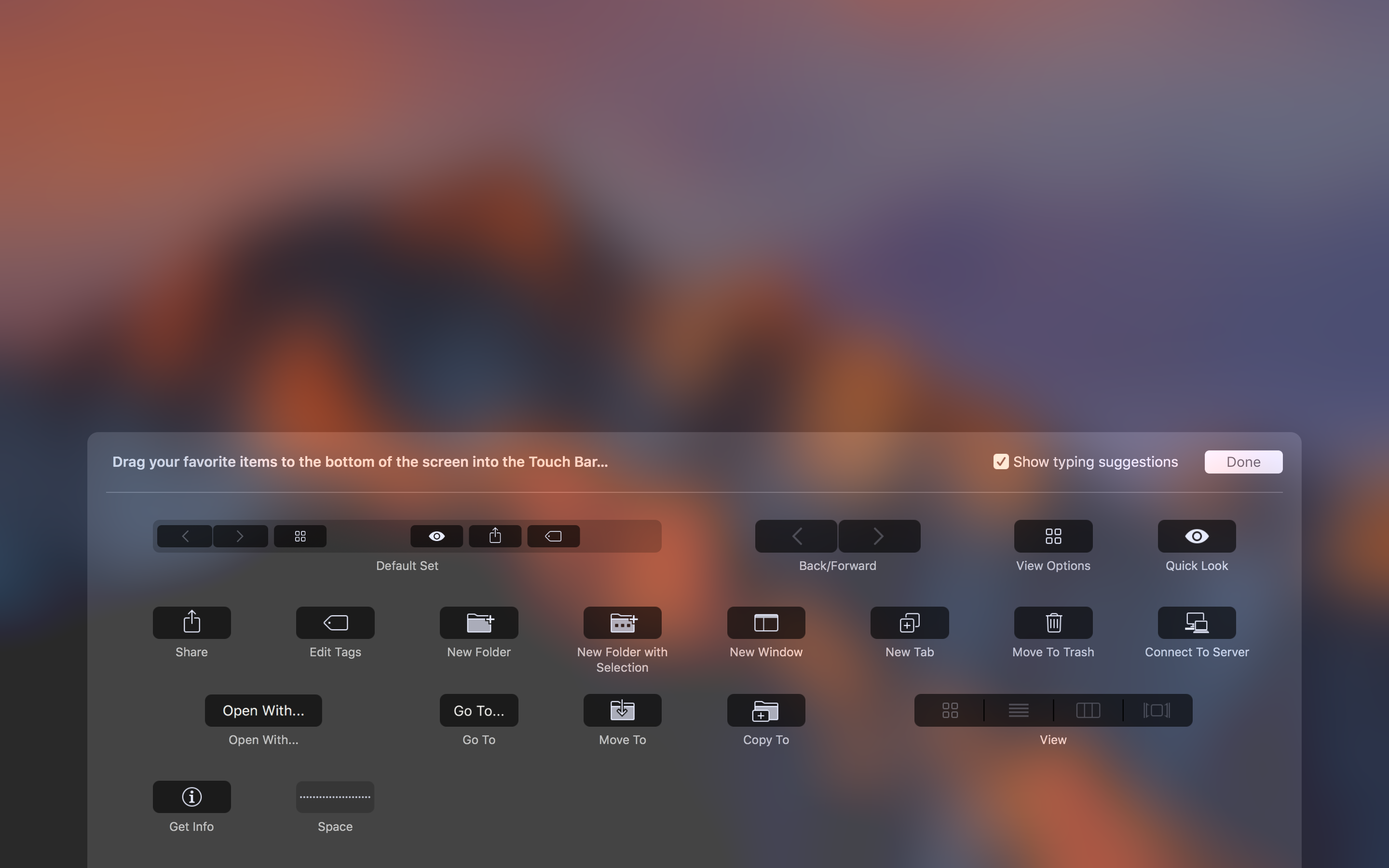
In addition to those four default Affect Bar shortcuts, you'll also observe an pointer sign, which allows you to expand that curt list of icons to fill out the entire affect strip. Though that full list might initially seem cluttered, I like it considering it'south more similar to the setup I'one thousand used to. For instance, with the shortcuts fully expanded, yous get separate buttons for increasing and decreasing the brightness. Ditto for volume: You'll see separate keys for volume up and down. Unfortunately, though, that expanded view fades away after a few seconds of idle time; in that location's no way to only lock in that function row and then that you lot see it there every time you await down at the keyboard.
In addition to expanding the Touch Bar menu, you tin tap the volume or brightness icons to bring up a slider. What's annoying about this whole setup is that either mode, some of the most important system controls are now buried in Bear on Bar menus. Want to lower the book? You lot can either hitting the book icon and swipe the slider, or hit the arrow key and tap the volume up or down key. That's less efficient than just pressing a dedicated volume button in the role row. It'south inconvenient enough that I eventually started using my mouse to practice things similar interruption Spotify or enhance the volume on a track. Apple made me alter my mode of doing things, and not necessarily for the better. That pisses me off.
Gallery: The 2016 MacBook Pro (15-inch) | eighteen Photos
Gallery: The 2016 MacBook Pro (fifteen-inch) | 18 Photos


Another thing: I too frequently stop up hitting the Touch on Bar when I mean to strike the Delete central. By default, it's Siri sitting in that spot higher up the backspace button, which means I've more than in one case summoned Apple's virtual assistant when I didn't hateful to. I did employ the settings carte to motility Siri over to the left, merely that but means something else will then be sitting in a higher place the Delete key, and you will accidentally hit that also. I'm frankly non sure what Apple tree should exercise about that. Maybe issue a software update that pushes those four shortcuts slightly left? Think on it, guys.
The Touch Bar works throughout the rest of macOS too, and occasionally information technology's actually useful. In Safari, for instance, you lot tin tap or slide to switch between open tabs. Also, when you put your cursor in the search field, your favorite websites will automatically pop upward. In Mail you'll meet predictive text, formatting options (bold, italics, etc.) and even suggestions for where you should archive highlighted messages.
The Messages app also has Quick Type give-and-take suggestions, along with emoji and "Tapback" responses. In Agenda, you tin select a day, month or year from the Touch Bar. Notes gives you checklists, formatting tools and, once once again, predictive text. Rounding out the list, in Photos you'll see a slider to scrub through your photos, forth with buttons for cropping, favoriting, rotating pictures, or calculation filters to them.
I call up the reason some of these use cases work is that many of the things I just mentioned -- picking emoji, accepting spellcheck suggestions -- are things we're already used to doing on touchscreens. Using iPhones for every bit long every bit nine years has prepared loyal Apple tree fans well for this moment. At the same fourth dimension, I can understand why Apple didn't become all in with a full touchscreen: macOS simply wasn't designed to exist finger friendly. Still, that didn't stop me from poking the screen in vain several times, with the expectation that the Mac would behave the same as any Windows laptop I've tested recently.
In add-on to those apps I mentioned, the Touch Bar works in other Apple tree programs like Pages, Numbers, Keynote and Final Cut Pro 10. The company has also released an API for developers, and indeed, we've already seen previews of upcoming apps that take advantage of the Touch Bar, like Photoshop and Microsoft Office. For now, though, every bit this is just the outset twenty-four hours that the Touch Bar MacBook Pros are on sale, the feature is mostly limited to first-party apps.
Operation and battery life
For its newest MacBook Pros, Apple went with sixth-, not seventh-generation ("Kaby Lake") Intel Core CPUs. Which makes sense, because the specific (read: more powerful) Kaby Lake processors that Apple would need for the MacBook Pro series aren't even available yet.
That said, even with the currently bachelor Intel chips, Apple is challenge some large performance claims -- upwardly to 130 percent faster graphics on the 15-inch model, and up to 103 per centum faster integrated graphics on the 13-inch model. The SSDs here are said to be upwardly to 100 percentage faster, with sequential read speeds of up to 3.i gigabytes per second and sequential write speeds of up to 2.1 GB/southward on the thirteen-inch model and upward to 2.2 GB/south on the fifteen-incher.
| Laptop | Geekbench 4 CPU test (64-bit, single-/multi-cadre) | Xbench |
|---|---|---|
| MacBook Pro 2016 (15-inch, 2.7GHz Core i7, 16GB RAM, 2GB Radeon Pro 455) | four,309/13,367 | 558.81 |
| MacBook Pro 2016 (13-inch, 2.9GHz Core i5, 8GB RAM, Intel Iris Graphics 550) | three,876/7,504 | 476.36 |
| MacBook Pro 2016 (13-inch, 2GHz Cadre i5, 8GB RAM, Intel Iris Graphics 540) | iii,756/seven,268 | 473.65 |
| Surface Book 2016 (two.6GHz Core i7-6600U, 16GB RAM, 2GB NVIDIA GeForce GTX 965M) | three,824/vii,189 | North/A |
As for disk speeds, the Blackmagic test showed average write speeds of 1.36 GB/due south on the 13-inch Pro and ane.84 GB/s on the xv. (Blackmagic capped all read speeds at two GB/s -- an error suggesting the test can't handle disks this fast.) In a separate experiment, I duplicated a six.02GB folder. This took as little as viii.two seconds on the 15-inch model and a like 8.44 seconds on the 13-incher.
Obviously, you're not going to encounter maximum read or write speeds in a scenario like that, since both are happening at the aforementioned time. That said, speeds of 734 MB/s (or 713 MB/south on the 13-incher) are none too shabby. An 8-second transfer time is pretty brisk, because how many photos, videos and other files I had in that six-gigabyte folder.
Kick-up took effectually fifteen seconds to the login screen on the entry-level thirteen-inch model, though I logged a faster x-2nd startup on my higher-specced 13-incher. In any case, this is on par with how concluding year's models performed. This might be a practiced time to mention, by the way, that Apple has washed away with its long-standing startup chime. I've been hearing some people say they miss it, but personally, I've been enjoying my silent kicking-ups.
Though the MacBook Pro wasn't intended for gaming, per se, for this kind of money it had better be able to do a passable job when pros feel like taking a break from work. For the purposes of this review, I installed Tomb Raider and used its built-in benchmark to measure frame rates. (Yeah, I observed actual gameplay too.)
At the game'south native resolution (one,440 ten 900 on the 13-inch Pro), I saw an average of 40.v frames per second on the entry-level model, with frame rates ranging from 48.8 all the way downwards to a sluggish xviii.8 at one point. On a more than souped-up 13-inch Pro (one with a Touch Bar), the frame rate average rose to 47.4, with a range of 21.3 to 58.1 in my tests. Whichever configuration you go, the gameplay will net out to playable frame rates at default settings, though I can't guarantee y'all won't run into any slowdowns.
As yous'd await, things ameliorate a fleck on the 15-inch model, which comes standard with detached graphics. The Radeon Pro 455 GPU in my unit of measurement delivered boilerplate frame rates of 53 frames per 2nd in Tomb Raider, with the default screen resolution of 1,650 x 1,050. Even the lowest frame rates were more than playable here, with the fps rating ranging from 31.4 to sixty.5.
| Surface Book with Operation Base (2016) | 16:fifteen |
| Surface Volume (Core i5, integrated graphics) | 13:54 / 3:twenty (tablet only) |
| Apple MacBook Pro 2016 (xiii-inch, no Touch Bar) | xi:42 |
| Surface Book (Core i7, discrete graphics) | 11:31 / 3:02 (tablet simply) |
| Apple MacBook Pro with Retina brandish (xiii-inch, 2015) | 11:23 |
| Apple MacBook Pro 2016 (15-inch) | 11:00 |
| HP Spectre x360 15t | ten:17 |
| HP Spectre x360 (13-inch, 2016) | 10:03 |
| Apple tree MacBook Pro 2016 (thirteen-inch, Touch Bar) | 9:55 |
| ASUS ZenBook 3 | ix:45 |
| Apple MacBook (2016) | eight:45 |
| Samsung Notebook 9 | viii:sixteen |
| Microsoft Surface Pro 4 | 7:15 |
| HP Spectre xiii | 7:07 |
| Dell XPS 15 (2016) | 5:25 (7:forty with the mobile charger) |
This would exist a adept time to talk almost operating temperatures. The 15-inch model in particular adds a split-blade fan design that promises more efficient cooling. Both models got hot on the bottom after only a few minutes of gaming, but in regular utilize they were more than tolerable to keep in my lap -- they sometimes got warm after a while, but never uncomfortably hot with more mundane use.
Apple rates both the 13- and fifteen-inch MacBook Pro for up to ten hours of battery life, and that'due south either with web surfing or iTunes movie playback. Even later on half a dozen bombardment tests, I'm withal noticing some inconsistencies in my results: xiii-inch battery life is sometimes in the 7- to eight-hour range, with some tests hinting at a ten-and-a-one-half-hour capacity. Testing on the 15-inch model has too been inconclusive. I've generally seen between nine and ten hours of video playback, but in i instance I exceeded the 13-hr mark by lowering the brightness slightly. I'll exist conducting more tests and updating this review with concluding battery life results.
(Update: It took a few bombardment cycles and some very specific system settings, but I somewhen saw the 15-inch model last 11 hours in the iTunes playback exam, with the 13-inch Touch Bar model coming in at nine hours and 55 minutes. The entry-level 13-inch Pro without the Touch Bar lasted 11 hours and 42 minutes in the same test. That said, I've heard other tech reviewers mutter of shorter bombardment life and I believe them — especially if they were judging past everyday employ as opposed to video playback.)
Even if nosotros take my best battery results as fact, though, it's worth noting that earlier-gen MacBook Pros lasted longer on a charge. In particular, the 13-inch MacBook Pro I tested a yr agone was rated for 12 hours of iTunes playback, and logged nearly 11 and a half hours in the same test I used this time. That's about on par with this year's entry-level, lower-spec model, but an hour and a half longer than what I got with the Bear upon Bar configuration.
And and then you accept to consider what other calculator makers are doing. Microsoft'southward updated Surface Book, which just began shipping yesterday, is rated for up to 16 hours, and I really got slightly more than than that in my video rundown test (and that was with a Core i7 processor and detached graphics, heed you). And while the Surface Book admittedly achieves that runtime with a heftier, 3.68-pound design, the same can't be said of the 13-inch HP Spectre x360 -- it lasted ten hours in our video test with a Core i7 processor and a 2.85-pound design that weighs less than either of Apple tree's MacBook Pros.
Taking all that into consideration, I'd be even happier with the battery life on the 13-inch model if Apple tree had been able to achieve the same thing with a lighter design à la HP, or if it had accepted a slightly heavier build in the name of ameliorate endurance.
Configuration options
The 13-inch MacBook Pro starts at $1,299 without the controversial Touch Bar. For the coin, y'all get a 2.0GHz dual-core Core i5 processor, 8GB of RAM, a 128GB solid-state drive, integrated Intel Iris 6100 graphics and just two USB-C ports. The non–Bear on Bar automobile is besides available with a bigger 256GB drive, a different 2GHz Cadre i5 processor and Intel Iris 540 graphics for $ane,499.
The Affect Bar models start at $ane,799, and it's at this tier, too, that you step upwardly from two USB-C ports to four. At that price you get a 2.9GHz dual-cadre Core i5 processor, 8GB of RAM, a 256GB SSD and Intel Iris 550 graphics. The top-end model has a 512GB drive, bringing the total to $1,999.
Well, bold you don't buy any add-ons. You tin can purchase a 3.1GHz Core i5 processor for $100 or a iii.3GHz dual-core Cadre i7 CPU for $300. Doubling the RAM to 16GB costs $200. A 1TB SSD, meanwhile, costs an actress $400. This means the nearly tricked-out xiii-inch Pro volition set you dorsum $2,899. Price of dongles not included.
Gallery: The 13-inch MacBook Pro (no Touch Bar) | 22 Photos
Gallery: The 13-inch MacBook Pro (no Affect Bar) | 22 Photos


If it's the 15-inch version y'all're afterwards, that starts at $two,399 with a 2.6GHz quad-core Core i7 processor, 16GB of RAM, a 256GB SSD and a 2GB AMD Radeon Pro 450 graphics carte du jour. An fifty-fifty pricier $2,799 configuration nets yous double the storage (512GB), a slightly faster two.7GHz quad-cadre Core i7 CPU and an incrementally better Radeon Pro 455 GPU.
From there, also, you have upgrade options. There's 1 more CPU tier -- a 2.9GHz quad-cadre Core i7 chip for $200. You tin can bump the disk chapters to 1TB ($400) or 2TB for a mighty $1,200 -- the first time the 15-inch Pro has offered that storage option at all. Lastly, there'south one more GPU option: a 4GB Radeon Pro 460 chip, available for an extra $100. All told, the nearly expensive 15-inch Pro you could go costs a stinging $4,299,
The contest
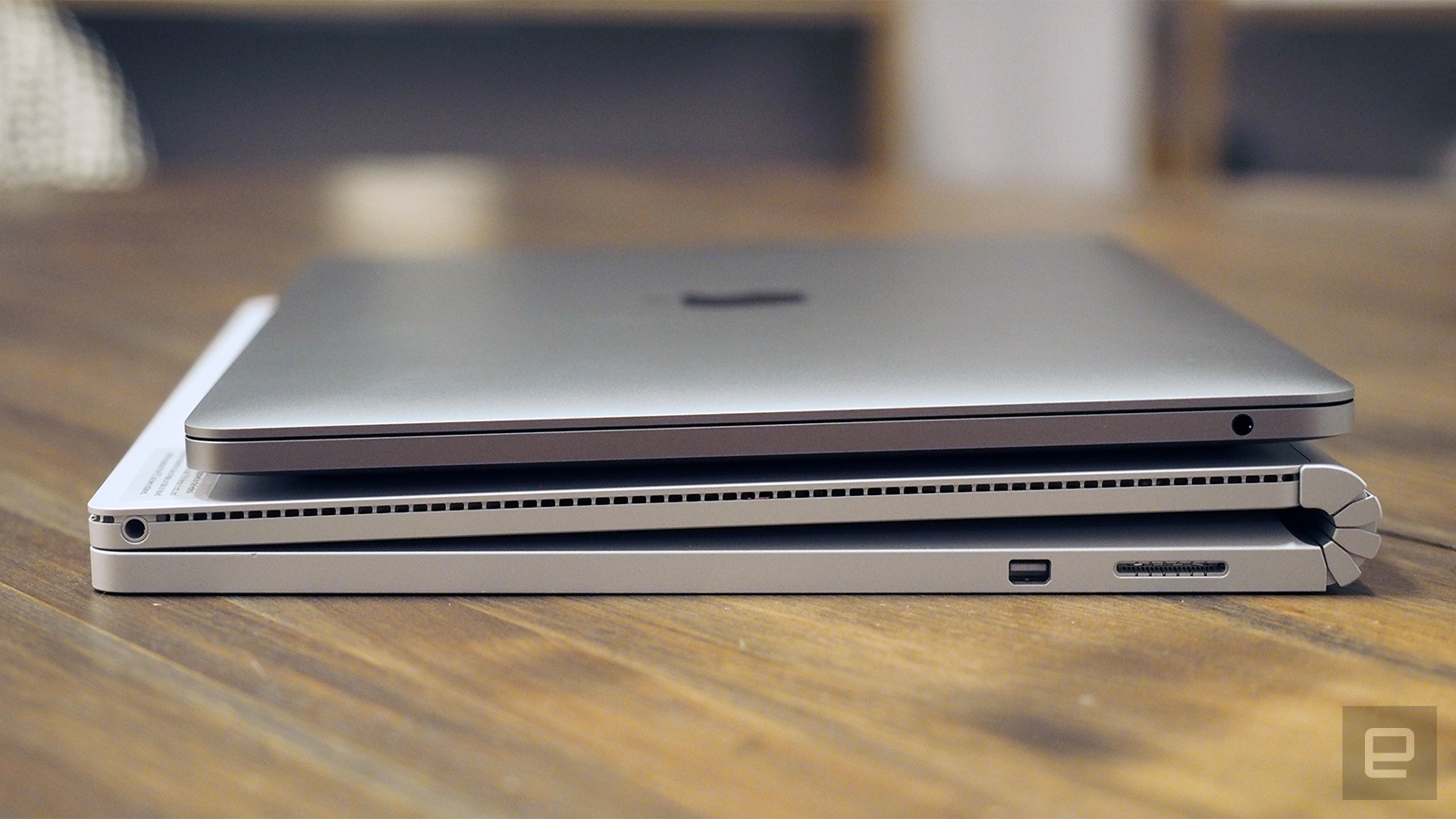
I tin think of a handful of machines I'd suggest yous add to your short list, and equally information technology happens I've reviewed all of them recently, or am in the middle of testing them now. The most obvious might exist Microsoft's updated Surface Book, which went on auction tardily terminal week and was met with positive reviews, including from Engadget. To recap my own review, its biggest drawbacks are that information technology's adequately heavy, at 3.68 pounds, and it's expensive. (Though last year'southward model is still around for $ane,499 and upward, y'all'll have to pay $two,399 and up for the newest configurations.)
If you tin can stomach the weight and price, though, you'll be rewarded with long battery life, a comfortable keyboard, aplenty ports, fast performance and a versatile design that allows you to detach the screen and utilise it as a pen-enabled tablet. (It'south a very lightweight tablet too, I might add together.)
People considering the 13-inch Pro would also be smart to consider HP'south newly updated Spectre x360 ($1,050-plus), which packs seventh-generation Intel processors and sports a more compact pattern. Yous likewise get a choice of 8GB or 16GB of RAM and betwixt 256GB and 1TB of storage. The graphics operation can't quite match the MacBook Pro, but it'due south otherwise fast, with a lighter design and longer battery life, not to mention a more than versatile design. Keep in mind, though, that the screen resolution tops out at 1080p, making it less pixel-dense than a Retina brandish.
Gallery: The Surface Book and MacBook Pro compared | 12 Photos
Gallery: The Surface Book and MacBook Pro compared | 12 Photos


Lenovo's new 13.nine-inch Yoga 910 ($1,050 and up; review coming soon) fits a like profile: 3.04 pounds with up to a Core i7 processor, Intel Hard disk 620 graphics, xvi GB of RAM and up to a 1TB SSD. Unlike on the like HP Spectre 360, though, there's a higher-res iii,840 x 2,160 screen option to rival the Retina display. You might even consider the 14-inch Razer Blade ($1,800 and up). Though information technology looks the function of a gaming laptop with its green logo and colorful keyboard backlighting, its portable design and specs (chiefly an NVIDIA GTX 1060 GPU) qualify it as a MacBook Pro competitor.
Lastly, don't count out Dell's XPS line. I recommend the 15-inch model in detail hither because it's i of the few other 15-inch laptops thin and powerful enough to rival the larger MacBook Pro. (The smaller XPS 13 is one of my favorite full general-purpose laptops, but it doesn't pack the graphics power to compete with the MBP.) The XPS xv, which starts at $1,000, weighs under 4 pounds, making it about as light as Apple's machine, and can exist configured with a 4K display, quad-core Core i7 CPU, a 2GB NVIDIA 960M GPU, up to 32GB of RAM and a 1TB SSD. That top configuration costs $2,600.
Wrap-up
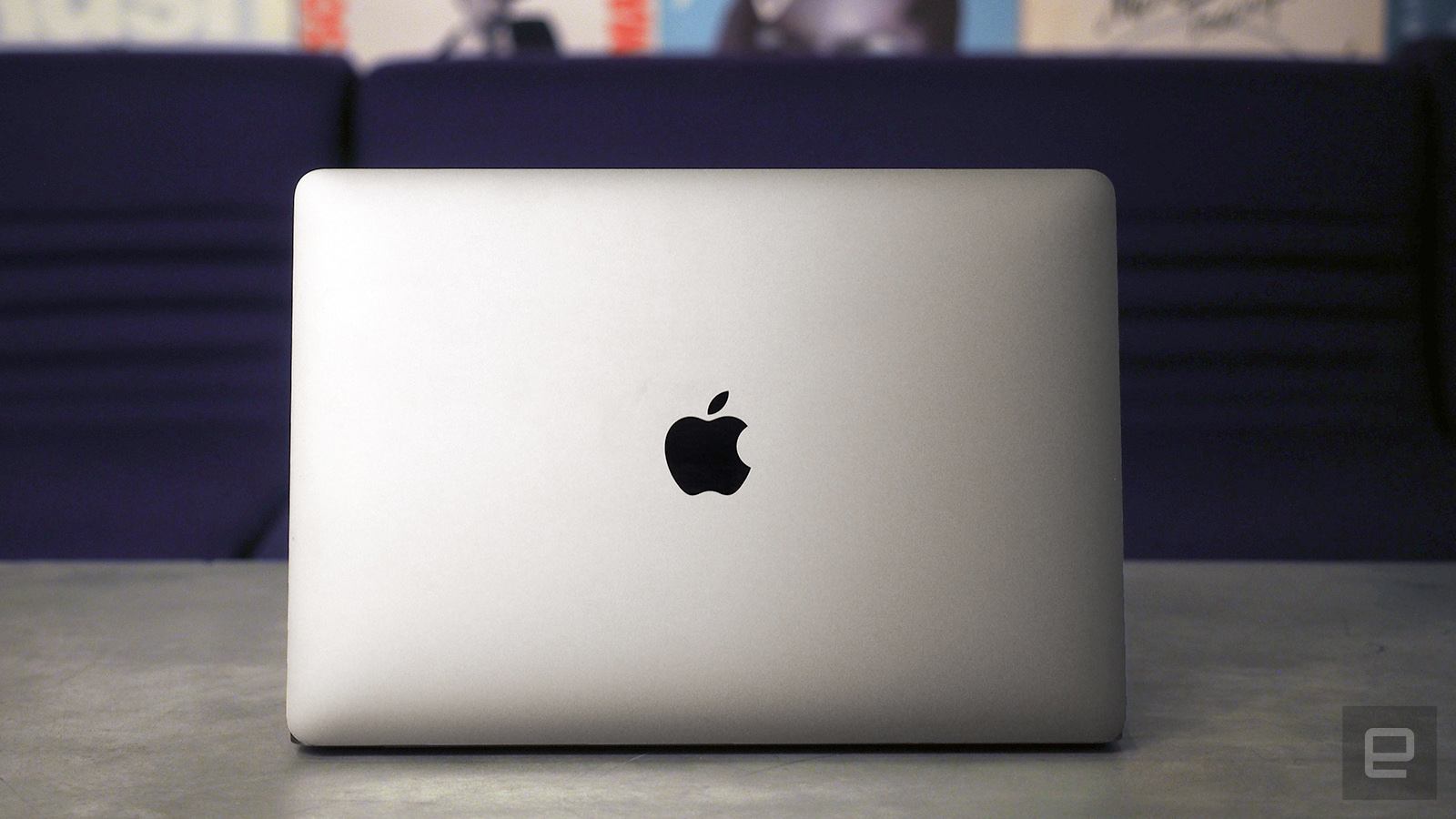
I'grand 1 of many Mac owners out there who has been waiting for Apple to upgrade the MacBook Pro line. At present that it finally has, I find the new laptop isn't quite what I wanted. For me, the ideal MacBook Pro is really a mashup between this and final year's model. Let me keep my full-size USB ports, and my function keys, and my longer battery life, but stick with this thinner and lighter design. Stick with this improved display, Touch ID sensor, fast disk performance and more robust audio quality. For me, this is both a step frontwards and a stride backward.
I'thou sure Apple disagrees, and not only because its task is to sell lots of computers. Apple seems to earnestly believe it knows how people should be getting piece of work washed -- and then much and so that it has the chutzpah to ask loyal customers to unlearn former habits. Become used to using dongles to attach your existing accessories. Say goodbye to your memory card slot, creatives. Resign yourself to adjusting the brightness or volume with taps and swipes, instead of a elementary button press. Accept the hazard that your existing Thunderbolt three peripherals might non piece of work.
As I said, there's ultimately a lot to like nigh the new MacBook Pro. Merely it's designed for someone who I'yard non sure exists outside Apple'southward fantasies of how professionals use computers. The MacBook Pro I want to see is congenital around real people's work habits. I still recommend it, and I imagine many of you who have been waiting patiently will indeed buy this. Just I'd bask it more than if it were designed for people like u.s..
Gallery: The new MacBook Pro family | 12 Photos
Gallery: The new MacBook Pro family unit | 12 Photos


All products recommended by Engadget are selected by our editorial team, independent of our parent visitor. Some of our stories include affiliate links. If you buy something through one of these links, we may earn an affiliate commission.
Source: https://www.engadget.com/2016-11-14-macbook-pro-review-2016.html
0 Response to "15 Apple Macbook Pro Review (2016 Touch Bar) Vs Old Vs New"
Post a Comment